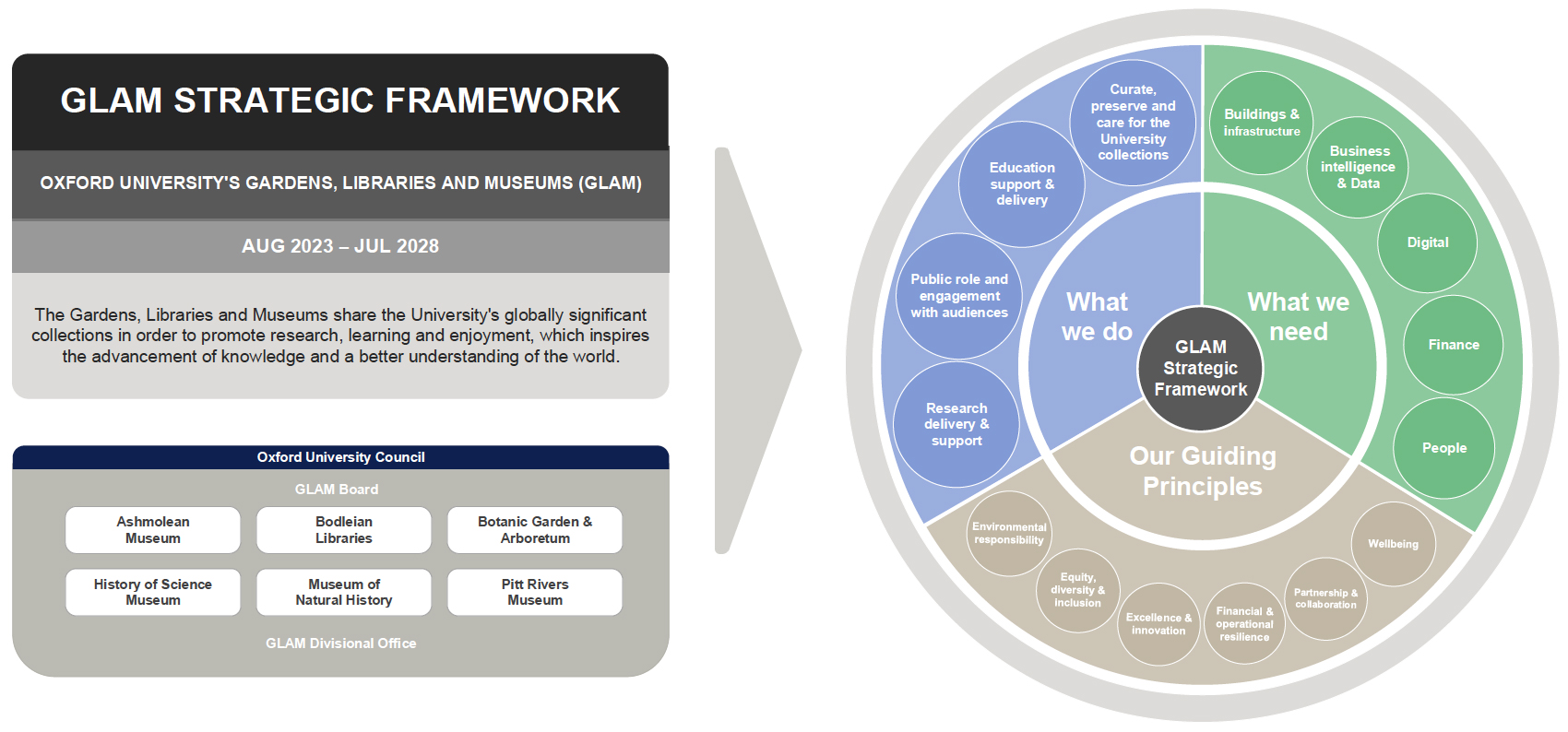
GLAM Strategic Framework

The Gardens, Libraries and Museums share the University's globally significant collections in order to promote research, learning and enjoyment, which inspires the advancement of knowledge and a better understanding of the world. 


Landscape diagram featuring text describing the GLAM Strategic Framework.

What we do…

Curate, preserve and care for University collections
To champion excellence in research, teaching and public access to the University of Oxford’s world-class collections, whose care and curation are dependent upon the knowledge and scholarship within GLAM.

  • We are stewards on behalf of the University and lead on collections care and conservation, including location management, documentation, preventative conservation, environmental management, cataloguing, loans, exhibitions, displays, and living plant collections.
  • We add to the collections to support the University’s mission, including managing born-digital collections.
  • We balance the access to and use of collections with preservation needs.


Research Delivery and Support
To play a significant part in the University’s research infrastructure by housing creative research programmes, enabling research from across the University and beyond, and driving innovative Public and Community Engagement with Research that connects with diverse audiences.

  • We deliver world-leading research through innovative research and engagement projects reaching local, national and global audiences.
  • We also provide support to internal and external researchers through access to our collections and our expertise.


Education Support and Delivery
To further our understanding of the world through teaching at all levels, from schools to post-graduate, and across the full disciplinary range of the University.

  • We deliver learning within primary and secondary schools, including the range of education pathways from primary to post-graduate.
  • We deliver and support undergraduate and post-graduate learning with our collections and spaces.
  • We support informal, formal, and user-led learning.
  • We work in partnership with academics to embed our collections in their teaching to improve the student experience.


Public Role and Engagement with Audiences
To deepen our knowledge of and engagement with audiences to develop exceptional, creative, onsite and online exhibitions, programming and services that truly meet audience needs.

  • We play an active part in the local community and contribute to the local economy (Oxfordshire).
  • We play an active leadership role in the relevant sector regionally, nationally and internationally.
  • We play an active role in the wellbeing of society through our spaces, collections and related research.
  • We engage with topics of public interest and remain relevant to audiences.
  • We aim to be the gateway to the University for local communities.

GLAM ambitions ('By 2028 we will have…')

University Collections

  • Improved the physical estate and standards of collections care – e.g. Collections Teaching & Research Centre (CTRC), Collections Storage Facility (CSF), Oxford Botanic Garden’s glasshouses.
  • Increased accessibility (both physical and virtual) for teaching and research through the CTRC, CSF and digitisation.
  • Ensured that the collections are appropriately labelled and curated in line with contemporary good practice, both physically and online.
  • Proactively engaged with problematic areas of our collections through consultation, collaborations, partnerships and research.
  • A clear roadmap to ensure appropriate digital preservation of our digital collections.
     

Research

  • Delivered and supported impactful collections-based research to enhance our understanding of the world.
  • Supported the University and contributed directly to the REF cycle.
  • Significantly increased our capacity for integrated digital research.
  • Increased recovery of externally funded overheads across our research portfolio.


Education

  • Transformed student experience with GLAM collections.
  • Responded to the changing needs of students, both in terms of content and delivery methods.
  • Improved the physical estate and increased access to collections for teaching – e.g. Collections Teaching & Research Centre (CTRC), Oxford Botanic Garden’s glasshouses. 


Public role

  • Enhance our vital role in the City of Oxford’s cultural and economic landscape through the development of exceptional, creative, onsite, offsite and online exhibitions, programming and services.
  • Enhanced our understanding of our audiences, delivering to those identified as a priority.
  • Measured and increased the impact that GLAM has on the Oxford City and Oxfordshire communities/economies.
  • Improved the physical estate to enhance public engagement – e.g. History of Science Museum (Vision 2024).


Operational Foundations

  • Ensured that we are financially sustainable.
  • Improved equity, diversity and inclusion within our workforce, making our spaces an ever-more inclusive workplace, and attract and retain people through investment in staff.
  • Developed meaningful local, regional and international partnerships.
  • Developed our work in supporting the brain health and wellbeing agenda, through delivering activities and increased partnerships with academic and external communities, including social prescribing.
  • Reduced our carbon footprint and increased awareness of environmental issues.
  • Developed and delivered a GLAM Digital Strategy to manage new collections and increase access to existing collections (e.g. digitisation and preservation), improving the efficiency of this work.
  • Delivered wellbeing activities for students and staff, as well as for members of the public, to enable happiness, fulfilment, and success.
  • Maintained relevance to the current issues of the day, having the flexibility and courage to respond to the external challenges that the world is facing.
  • Communicated, partnered and engaged with colleagues across the University and the Students’ Union.